The Old Mosque (Mersin) — the port city’s first minaret on the Mediterranean coast
In the heart of Mersin’s commercial district, amid the bustle of street stalls and the scent of fresh spices, stands the Old Mosque (Mersin)—the city’s oldest functioning mosque. Its low silhouette, with a wooden gabled roof instead of the usual dome, does not immediately catch the eye of a tourist accustomed to the grandiose structures of imperial Istanbul. But it is precisely the modesty of this building that makes it special: the Old Mosque (Mersin) is a living witness to a time when Mersin was just a small coastal town, not Turkey’s third-largest port by cargo volume. Built in 1870 by order of Sultan Abdulaziz, the mosque preserves within its walls a history and architectural distinctiveness that sets it apart from other religious structures along the coast.
History and Origin of the Old Mosque (Mersin)
In the 19th century, Mersin was a small settlement on the shores of the Mediterranean Sea. The coastal strip on which it stood belonged to a waqf—a religious endowment—established by Besmialem Sultan, the mother of Sultan Abdulmejid. A waqf is a form of inalienable charitable property under Islamic law, similar in concept to European religious foundations or monastic estates.
In the 1860s, a new sultan ascended the throne—Abdülaziz, who was the stepson of his stepmother, Besmialem Sultan. He decided to commemorate the founder of the waqf by erecting a mosque and a fountain in her honor. Construction of the fountain and its water supply system was completed in 1865; five years later, in 1870, the mosque was also finished. Both structures were originally named after Besmialem Sultan, the founder of the waqf. Over time, the unofficial name “Eski Cami”—the Old Mosque—superseded the official one, as it became the city’s oldest continuously operating Muslim place of worship.
Over the course of its 150-year history, the mosque has undergone three major renovations: in 1901, 1943, and 2008. Each renovation brought the building back to life while preserving its original appearance. The mosque has weathered all historical upheavals—Mersin’s transformation from a small fishing village into the region’s largest port city, two world wars, and the period of liberation from French occupation in the early 1920s. Today, surrounded by modern administrative buildings, it seems to preserve the memory of all the generations of townspeople who came here to pray.
Architecture and What to See
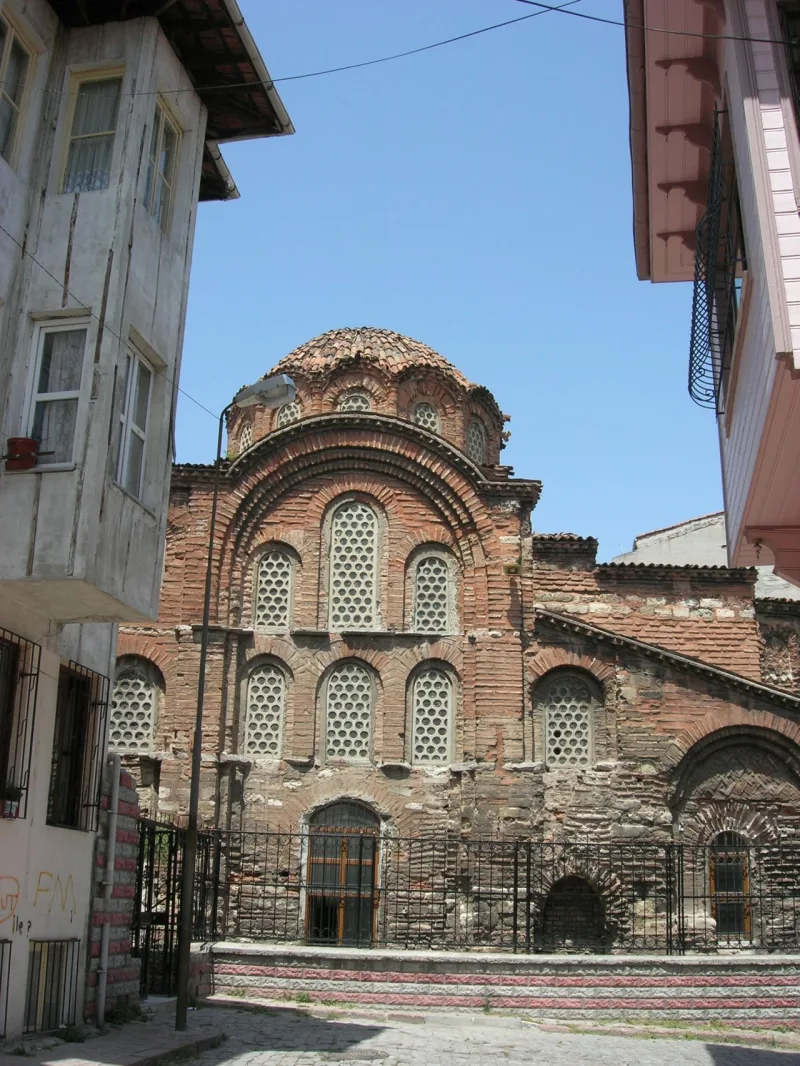
The Old Mosque (Mersin) is a small but architecturally remarkable building that starkly differs from the canonical Istanbul style. Its main feature immediately catches the eye: instead of a traditional dome, the mosque is covered by a wooden gabled roof. This element is characteristic of 19th-century provincial Ottoman architecture in regions where there were no local traditions of dome construction.
Volume and Layout
The building has a rectangular floor plan. The total area of the mosque, including the narthex (vestibule) and courtyard, is about 600 square meters—comparable to a small Orthodox church. This clearly illustrates just how modest Mersin was at the time of construction: the building, commissioned by the sultan himself, bears no resemblance in scale to the palace mosques of Istanbul.
Mihrab and Interior
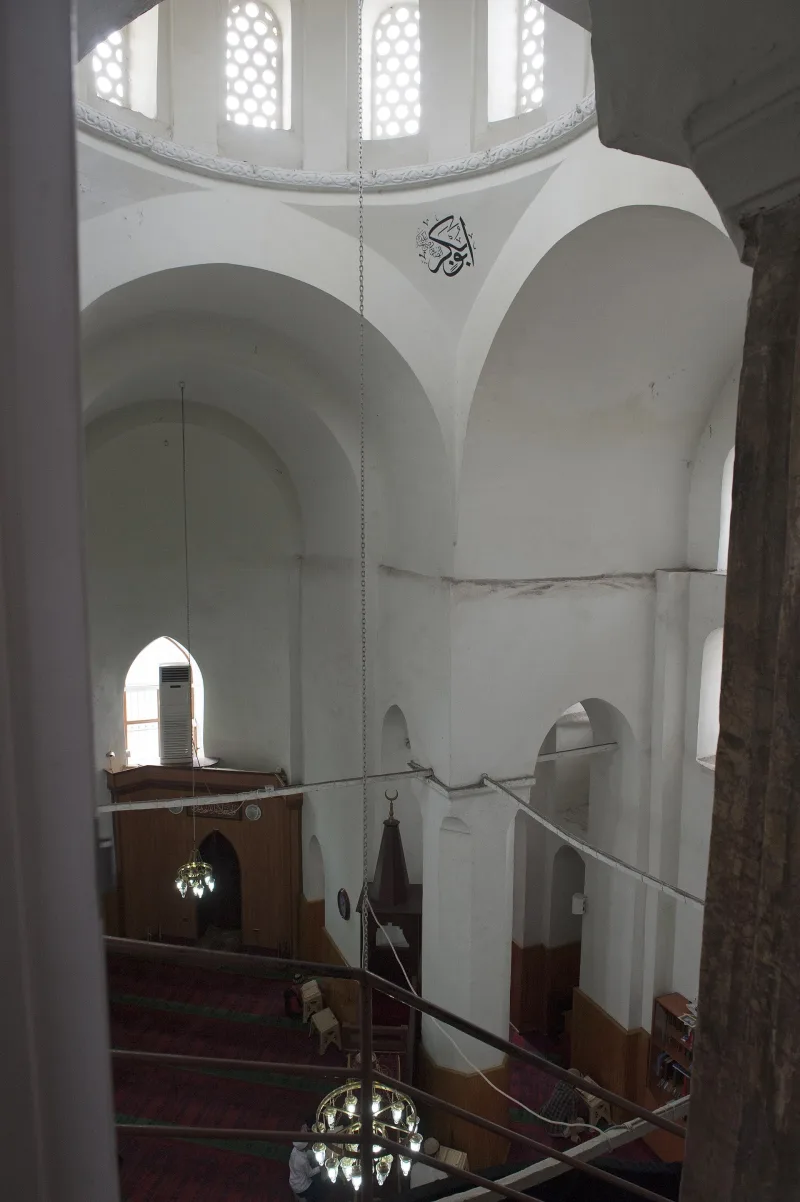
Inside the mosque, the mihrab—a niche indicating the direction of Mecca—is set into a wall niche. The interior is modest: wooden ceiling structures, lime-washed walls, and narrow window openings. The light filtering through the small windows creates a quiet, contemplative atmosphere inside, conducive to prayer. Nothing ostentatious—a typical style of provincial mosques from the late Tanzimat era.
Minaret
The mosque is single-minareted: it has one minaret. Its simple proportions correspond to the overall spirit of the building—no excesses, strict functionality. The minaret is built in the style characteristic of 19th-century Ottoman structures.
Şavırvan Fountain
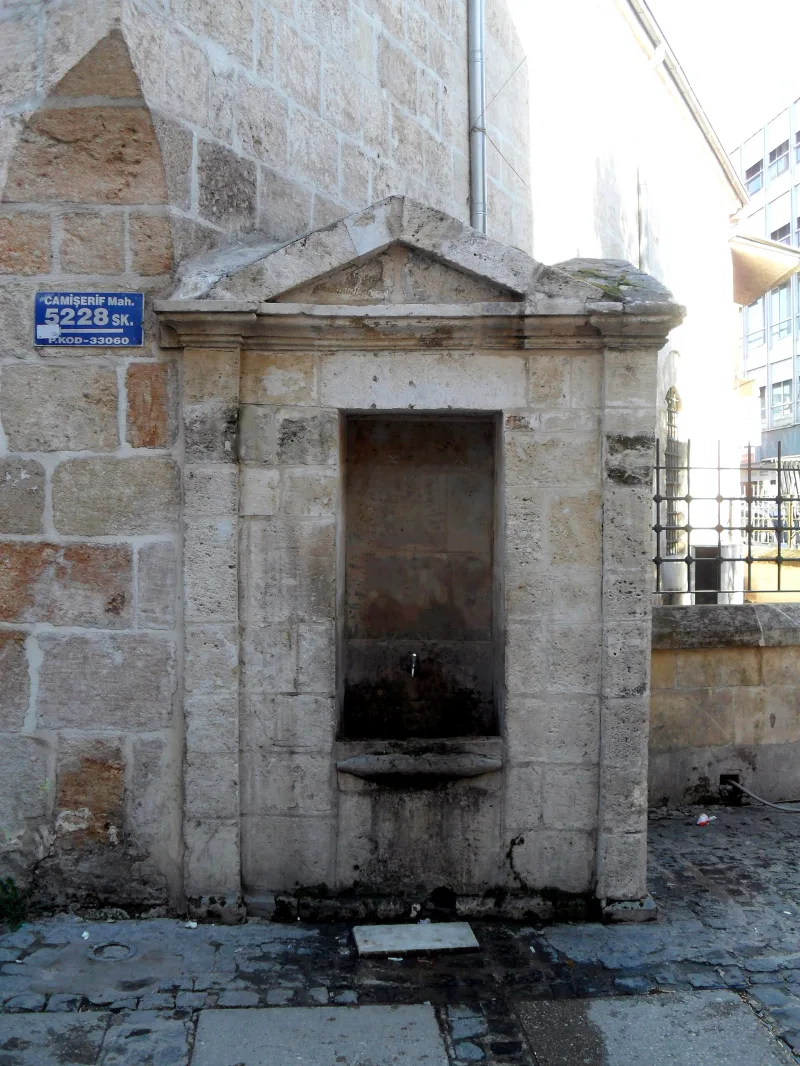
An integral part of the complex is the Şavırvan Fountain—built in 1865, five years before the mosque itself. Its distinctive feature is that, unlike most mosque fountains for ritual ablutions, this fountain is not located in the mosque courtyard but faces Uray Street on the south side of the building. The fountain has been preserved and continues to function today as part of the urban landscape.
Urban Setting
The mosque stands in Mersin’s commercial district, on the bustling Uray Street. The provincial governor’s office is 200 meters to the east, and the municipality is 400 meters to the southwest. Despite its proximity to modern administrative buildings, the mosque does not get lost in the crowd: its modest silhouette with a minaret stands out clearly against the backdrop of the city’s architecture.
Interesting Facts and Legends
- A wooden gabled roof instead of a dome is an architectural rarity for mosques built by royal commission. Most of the empire’s sultan’s mosques were distinguished by majestic domes. The modest scale of the Old Mosque (Mersin) eloquently speaks to what an insignificant provincial town Mersin was in 1870.
- The mosque was built in memory of Besmialem Sultan—the mother of Abdulmejid and stepmother of Abdulaziz. The waqf bearing her name owned the entire coastal strip where present-day Mersin stands. Such waqfs served as instruments of both charity and the consolidation of land ownership.
- The mosque has undergone three renovations over the past 150 years—in 1901, 1943, and 2008—while retaining its original appearance. The most recent restoration in 2008 was the most extensive and included the reinforcement of the wooden ceiling structures.
- The Şavırvan Fountain next to the mosque is one of the few in the city that faces directly onto the street rather than being hidden in a courtyard. This is an atypical design for Islamic religious architecture and reflects the specific urban planning of 19th-century Mersin.
How to get there
Mersin is served by Adana Airport (ADA)—the distance is about 65 km, and the trip takes about an hour by bus or taxi. There are direct flights to Adana from Istanbul and Ankara. From the Mersin bus station, it is convenient to reach the city center by city bus or taxi; the trip takes 10–15 minutes.
The Old Mosque (Mersin) is located in the commercial district on Uray Street. GPS coordinates: 36.7984° N, 34.6302° E. It is about a 10–15-minute walk from the Mersin waterfront. Public transportation: most city routes pass through the center. The mosque is open to visitors outside of prayer times, and admission is free; during prayer times, tourists are advised to remain quiet and observe the dress code.
Tips for travelers
The mosque is open daily. Visits are possible at any time outside of prayer hours—it is best to avoid the prayer schedule. Women are advised to bring a headscarf; shorts and bare shoulders are discouraged.
Other attractions are located nearby: the Mersin Historical Museum, the waterfront promenade, and the bazaar street. Mersin is a convenient base for day trips to Tarsus (30 km to the east), home to St. Paul’s Church, the Old Mosque, and other landmarks, or westward to Mamure Castle and Silifke.
If you plan to visit several sites in Mersin in a single day, the Old Mosque will take you 20–30 minutes, including a stroll through the shopping district and a visit to the Şavırvan Fountain. The best time of day for photography is in the morning, when the side lighting highlights the texture of the facade and minaret. Combine your visit with a tour of the local market—the shopping district around the Old Mosque (Mersin) preserves the spirit of an old Mediterranean city.